What Is Payday Super?
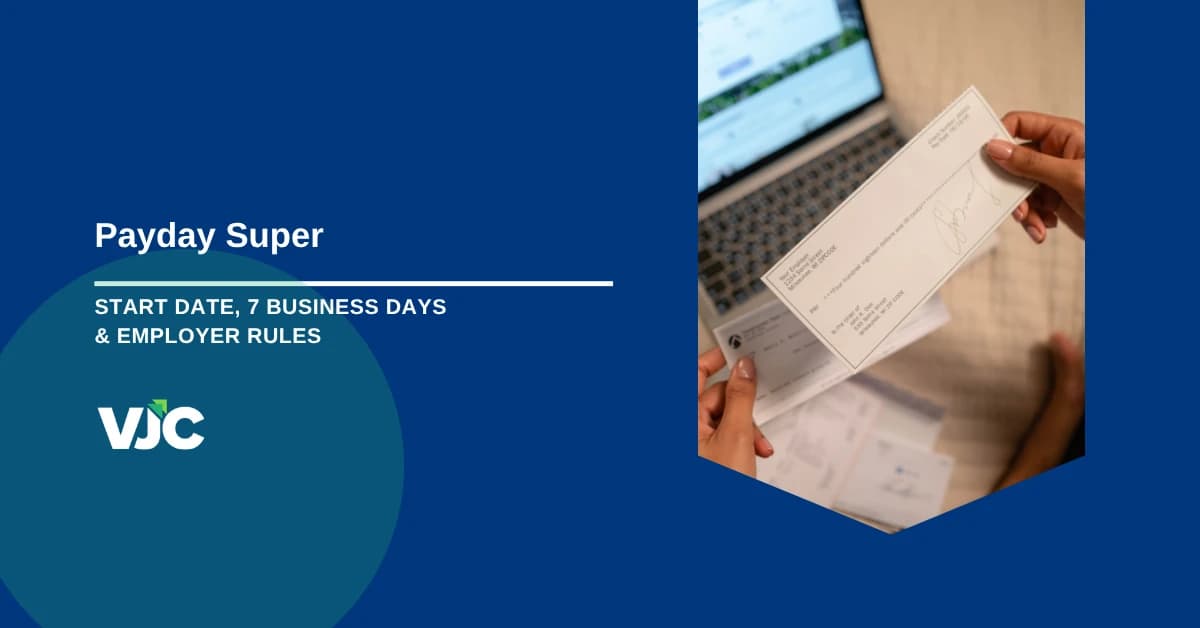
So, what is payday super in Australia? Well, Payday Super is a reform to Australia’s superannuation system that requires employers to pay their employees’ super guarantee contributions at the same time as their regular wages.
At the moment, most employers pay super quarterly. But as per the new framework of July 2026, superannuation will be paid at the same time as salary and wages, with contributions generally required to be received by the employee’s super fund within 7 business days.
The Payday super reform applies to all Australian employers who are currently required to pay super guarantee, regardless of business size or industry. The super guarantee rate still remains 12%. But what changes is not how much you pay, but how often and how quickly those contributions need to reach your employees’ funds.
The main intent of the government was to tackle the persistent problem of unpaid and underpaid superannuation. Under the quarterly system, gaps between earning super and receiving it can stretch months
With the new laws, employees will receive their super sooner, missed contributions will become easier to identify, and employers will avoid building large unpaid super liabilities over several months.
So, at a surface level, here’s what changes:
| Before 1 July 2026 | From 1 July 2026 |
|---|---|
| Super generally paid quarterly | Super generally paid every payday |
| Contributions due within 28 days after each quarter | Contributions generally due within 7 business days of payday |
| Super calculated on ordinary time earnings | Super calculated on qualifying earnings |
| Quarterly reporting cycle | More frequent reporting through STP |
For CEOs and CFOs like you, the impact of payday super can show up in your payroll schedule, cash flow plans and internal processes. So, use this as an opportunity to streamline payroll and finance functions.
If managing payroll and super compliance alongside BAS preparations, workpapers, and tax returns is already stretching your capacity, you might want to explore how outsourced accounting services can free up your time and reduce risk.

How Does Payday Super Work?
So the super payday runs on a strict timeline. Missing the payment window could lead to compliance issues, even if wages were paid on time.
Here is exactly how the money moves from yours to the employee’s account:
Step 1: Calculation
Run payroll as usual by calculating wages and other payroll obligations of your employees. Now, along with that, calculate their super guarantee (SG) amount based on their qualified earnings. It’s usually 12% of ordinary time earnings, commissions, and salary sacrifice contributions.
Step 2: Meet the Deadline
You then send that amount to each employee’s super fund. The clearing house processes the payment.
P.S. You can stop paying once your high-income employees reach the maximum contribution base
Step 3: Report through STP
Report both qualifying earnings and the super liability through Single Touch Payroll (STP) to the ATO as part of your regular payroll process.
That’s it. The biggest change isn’t how you calculate super. It’s making sure every payment reaches the right fund on time, every pay cycle.
When Does Payday Super Start?
The payday super start date is determined by the actual date your employees are paid. From that date, all organisations must comply with the new payment timing requirements. The funds must be credited within 7 business Days.
However, there is an exception.
For new joinees or employees who have changed funds, organisations have a longer timeframe of 20 business days to make their first payment.
P.S. There is no phased rollout based on business size. Whether you employ one person or one hundred, the rules apply from the same date.
Has Payday Super Been Legislated?
Yes, the Treasury Laws Amendment (Payday Superannuation) Act was passed by the Australian parliament in late 2025 and took effect on 1 July 2026.
The legislation covers the new payment timing rules, the updated super guarantee charge, the closure of the Small Business Superannuation Clearing House, and revised SuperStream data standards.
So, all in all, the core framework is settled. But because payroll and super rules continue to evolve, it’s worth checking the ATO’s Payday Super guidance whenever updates are announced.

What Are The Key Changes To Payday Super In 2026?
The payday super changes go beyond just paying more often. Here is a detailed breakdown of what actually shifts:
| Points of difference | Old rules | New rules from 1 July 2026 |
|---|---|---|
| Payment frequency | Quarterly (4x year) | Every payday |
| Payment timing | Up to 28 days after quarter end | Within 7 business days from payday |
| Earnings base | OTE (excludes salary sacrifice) | Qualifying earnings (includes salary sacrifice) |
| SG charge deductibility | Not tax deductible | Tax deductible |
| SG charge calculation | 10% interest + $20 fee per employee per quarter | Daily compounding interest (GIC rate) + up to 60% admin uplift |
| SGC-related penalty | Up to 200% of SG charge | 25% or 50% of unpaid SG charge (depending on prior penalties) |
| Clearing house | SBSCH available to existing users | Closed from 1 July 2026 |
| Fund allocation timeframe | 20 business days | 3 business days |
| STP reporting | OTE or super liability | Both qualifying earnings AND super liability |
What Are The Key Changes For Employers?
For employers, the payday super reforms introduce obligations that go beyond just hitting a different deadline. Here is what you need to get right:
- Payroll software readiness – Your system must calculate super on qualifying earnings (not just OTE), report both qualifying earnings and super liability through STP, and initiate payments through updated SuperStream channels.
- Cash flow planning – Moving from four super payments a year to 26 or 52 changes when money leaves your account. For a business with $50,000 in weekly wages, that is $6,000 in super going out every week instead of $78,000 once a quarter.
- Clearing house transition – If you still use the Small Business Superannuation Clearing House, you must move to a SuperStream-compliant alternative before 1 July 2026.
- Compliance is now real-time. Payday Super gives the ATO greater visibility by allowing it to compare employer STP reporting with information reported by super funds. This way, they can identify potential unpaid or late super sooner.
Does Payday Super Apply To All Businesses?
In most cases, yes. If your business has employees who are entitled to super, Payday Super applies to you from 1 July 2026, regardless of whether you employ two people or two hundred.
That said, the ATO has said it will take a practical, risk-based approach in the first year, focusing compliance action on higher-risk behaviour rather than chasing every business at once. This means the ATO’s compliance activities will be guided by the level of risk, with greater attention given to higher-risk behaviour.
What Is The Payday Super Payment Timeline?
Super used to be a quarterly obligation. That’s gone. Now, each time you pay your employees, a seven-business-day clock starts. Within that window, the contribution must be received by the employee’s fund with enough information to allocate it to their member account.
The frequency of your super payday obligations matches your existing pay cycle:
| Pay cycle | Super payments per year | Super Pay Deadline applies from |
|---|---|---|
| Weekly | 52 | Each weekly payday |
| Fortnightly | 26 | Each fortnightly payday |
| Monthly | 12 | Each monthly payday |
So, the earlier you process super after payroll, the more buffer you have if a payment is delayed or rejected.
How Long Does It Take For Payday Super To Be Processed?
While employers have 7 business days to meet the deadline, the payment itself isn’t instant. Yes, it can settle faster than traditional bank transfers, but same-day settlement is not guaranteed.
That’s because it passes through your payroll system, payment provider and SuperStream before reaching the employee’s super fund. If any details don’t match, such as an incorrect member number or fund information, the payment may be delayed or returned.
This is exactly why many businesses choose to process super soon after payroll instead of waiting until the end of the 7-day window.

Why Is Payday Super Happening?
Now, what could be the reasons behind such legislation? So unpaid super has been a big problem in Australia, wiping out $6.3 billion every year that could have been employee retirement savings.
The reason for this is the old quarterly system made it too easy for gaps to go unnoticed for months. And by the time it was flagged, the employer might already be behind on several quarters.
By linking super payments to every payday, the Australian Government aims to:
- Help employees receive their super sooner.
- Make unpaid or late super easier to identify.
- Reduce large unpaid super debts building up over a quarter.
- Improve the accuracy and transparency of payroll reporting.
For businesses, this step reduces the risk of missed deadlines and unwanted penalties.
How Do You Get Ready For Payday Super?
Getting ready mostly comes down to payroll, payments, and data. Here are a few tips to follow:
- Review whether your payroll software supports Payday Super.
- Check that employee super fund details are complete and accurate.
- Update your payroll calendar to include super payments every payday.
- Allow enough time for payments to be processed before the 7-business-day deadline.
- Review your internal payroll approval process so payments aren’t held up.
- Build it into your cash flow planning the same way you would PAYG withholding.
- Speak with your accountant or payroll adviser if your current process relies on manual steps.
At the end, the main idea is to treat super as a normal part of running payroll, not a separate quarterly chore.
What Are The Roles Of The ATO And APRA?
The Australian Taxation Office (ATO) and the Australian Prudential Regulation Authority (APRA) oversee Australia’s superannuation. While both play different roles, their goal is the same: making sure super contributions are paid, processed, and allocated correctly.
The ATO focuses on the employer-facing side of compliance. It administers the Payday Super rules, monitors whether contributions are paid on time, collects reporting through Single Touch Payroll (STP), and takes action when businesses don’t meet their obligations.
APRA, on the other hand, oversees the operational safety of super funds. It regulates RSE licensees, ensures funds operate safely, and maintains systems that support the new payment requirements.

What Happens If Payday Super Requirements Are Not Met?
What was once a quarterly obligation is now tied to each payday. Under the Payday Super framework, the day an employer pays Qualifying Earnings (QE) to or for an employee is known as a QE day (Qualifying Earnings day).
Each day qualifying earnings are paid is treated as a separate QE day, and it generally starts the 7-business-day period for the employee’s super contribution to reach their super fund.
But what happens when you miss the deadline?
The ATO may treat the contribution as late. And depending on the circumstances, the employer becomes liable for the super guarantee charge, interest, and additional penalties.
Say you pay an employee $2,000 in qualifying earnings on 10 February 2028. Super guarantee on that is $240. If it reaches their fund within 7 business days, it’s cleared. But if it lands on 28 February instead, the contribution is treated as late, and you may need to pay the Super Guarantee Charge even though the payment was eventually made.
So, the message from the government is clear. Get it right on time, or the cost escalates quickly.
What Payday Super Resources Are Available?
By now, you have probably realised that Payday Super isn’t just a payroll update. It changes how you calculate, pay, report, and track super contributions every payday. The good news is that you don’t have to work it out alone.
The ATO’s Payday Super page is the most authoritative resource. Rather than relying on social media posts or second-hand summaries, it’s worth bookmarking the official guidance and using it as your reference.
It covers payment deadlines, qualifying earnings, the updated super guarantee charge, and transition guidance for clearing house users. The ATO also publishes webinars and guidance videos that walk through specific scenarios.
| Resource | Why it matters |
|---|---|
| ATO Payday Super guidance | Official rules, payment deadlines, qualifying earnings and employer obligations. |
| ATO webinars and videos | Practical walkthroughs for common employer scenarios. |
| SuperStream guidance | Explains how super payments move between payroll systems and super funds. |
| Your payroll software provider | Shows how Payday Super works within your existing payroll platform. |
If your business previously relied on the Small Business Superannuation Clearing House (SBSCH), remember that it closed on 30 June 2026. Employers now need to use an alternative SuperStream-compliant payment solution.
Need an extra pair of hands? At VJC Partners, we do smartsource accounting work for Australian firms, helping practices free up capacity while maintaining quality. If you’d like to see how we work, send us your details by filling out the enquiry form and our representative will reach out to you.
Frequently Asked Questions About Payday Super
What Is The Meaning Of Payday Super?
Payday super is a legal requirement in Australia where employers pay super guarantee contributions for each payday rather than quarterly.
How Does Payday Super Actually Work?
Each time you run payroll, you calculate super on qualifying earnings and send the contribution to your employee’s fund within seven business days. You report both the earnings and the liability through Single Touch Payroll.
How Long Do Employers Have To Pay Payday Super?
Employers generally have seven business days from each payday for super contributions to reach the employee’s super fund. However, certain first contributions for new employees or employees who change super funds can have a longer timeframe of up to 20 business days.